
An interactive tool for learning Arabic
Abji activities give children a clear task: listen, distinguish a letter, choose a form or understand a word. Play presents these tasks in an interactive setting, connecting letters with their forms and positions in words. Parents can follow the experience and review results with their child.
The learning content is Arabic. Interface text, instructions and assistance are available in Arabic, English and German. The screenshots below show the English interface.
- 80
- rounds in the Arabic curriculum
- 28
- Arabic letters
- 4–8
- years: intended age range
80 rounds with clear learning goals
The Arabic curriculum has four learning paths. Each round has its own goal and content, with activities selected to suit that goal. The activity mix varies between rounds.
24 Rounds
Letter forms
Letters and their forms, letters within words, and letter positions.
24 Rounds
Word building
Building words, connecting letters with words, and recognising words.
24 Rounds
Early reading
Reading words and sentences, with comprehension tasks.
8 Rounds
Language challenge
Reviewing language skills through comprehensive challenge rounds.
What happens in a round?
A goal before play
The “What will we learn?” screen introduces the round’s topic and instructions, with an example of the task.
Instructions and interaction
The child listens and takes part in the available activities: choosing an answer in Race, dragging and matching, or writing and tracing.
Results and review
Results appear after play. Parents and children can review rounds, answers and mistakes, then practise again.
The Bāʾ journey: a real example from Round 2
We follow Bāʾ (ب) and the word باب (door) to show how one idea carries across activities. Round 2 also includes other letters; this example focuses on Bāʾ.
Step 1
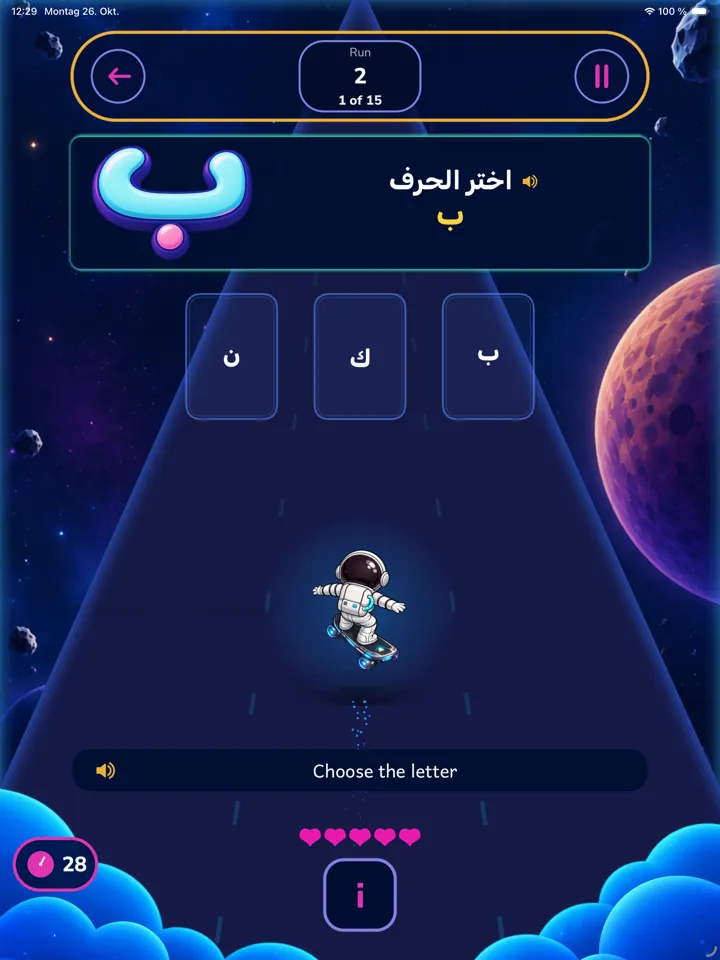
Listen and recognise the letter ب
Race displays the requested letter and audio instructions. The child chooses Bāʾ from the letters shown, such as Nūn and Kāf.
Learning goal
Practise distinguishing letter shapes and connecting a letter’s name with its form.
Step 2
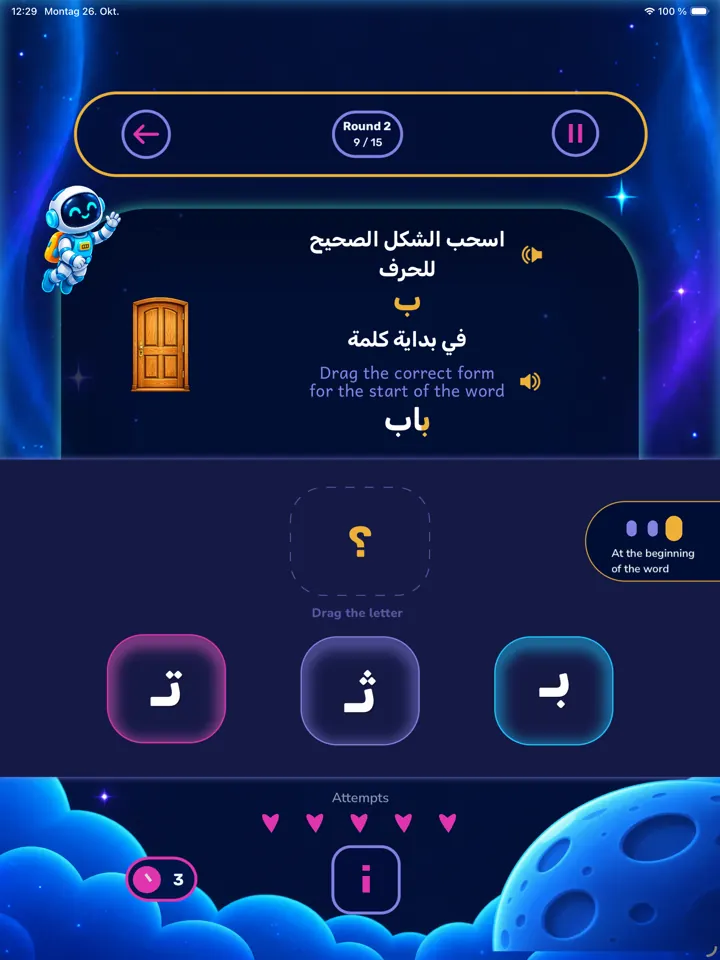
Choose its form at the start of باب
The word باب and a picture of a door provide context. The child drags the correct letter form into place, exploring how a letter’s shape depends on its position and connections.
Learning goal
Recognise initial Bāʾ in a word and compare it with alternative forms.
Step 3
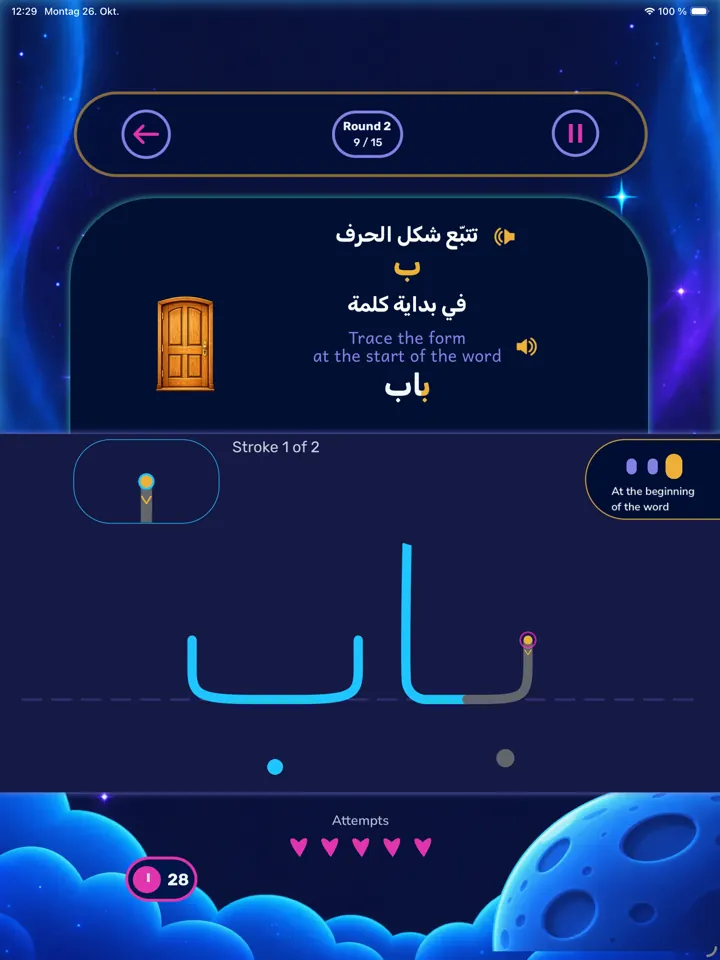
Follow the starting point and stroke order
In the writing area, the child starts at the glowing point and follows the guided path step by step. The activity connects tracing with Bāʾ at the start of باب and shows the order of the movements.
Learning goal
Practise where to start, which direction to move and how to form the letter’s strokes.
Step 4
From the screen to pen and paper
For supported writing rounds, the app can generate a PDF worksheet for printing. It includes tracing models and space to write, based on the round’s writing content. Parents can use it to continue practice away from the screen.
- Complete the writing activity in a supported round.
- Open the writing worksheet and print option on the results screen.
- Save or share the PDF for printing and use it with your child.
- Trace the dotted models, then try writing on the empty lines.
PDF worksheets are available for writing rounds supported by the app. Not every one of the 80 rounds includes writing or a printable worksheet.
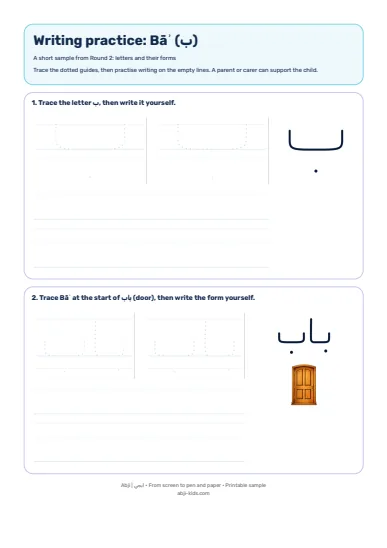
Try a Bāʾ writing sample
A short sample from Round 2: isolated Bāʾ followed by its form at the beginning of باب. This printable example is not the complete round worksheet.
Open the printable Bāʾ sample PDFOne A4 page • English instructions • Print at 100% scale
A parent’s role: support and review
Listen to the task together when needed and give your child time to try. Use round reports, results and mistakes to decide what to revisit, then continue practice on screen or paper without turning the session into a test.
Questions about the learning journey
Is Abji a game or an educational tool?
Abji is an interactive educational tool that uses play to present Arabic learning tasks: letter recognition and forms, word building, early reading and writing.
Does every round include Race, Drag & Drop and Writing?
The activities depend on the round’s goal and content. The Bāʾ example shows all three, but not every round uses the same sequence or includes writing.
Can we print practice after every round?
PDF worksheets are available for rounds that support writing activities. Some rounds focus on recognition or comprehension and do not include a writing worksheet.
Does this curriculum teach English or German?
This curriculum teaches Arabic. English and German, alongside Arabic, are available for the interface, instructions and assistance.
Is the sample the complete round worksheet?
The sample is one short page focusing on Bāʾ and باب. The worksheet generated in the app may include other letters and examples depending on the round’s writing activities.